What Is a Transcript? Ways to Make One, What It Costs, and Which Tools
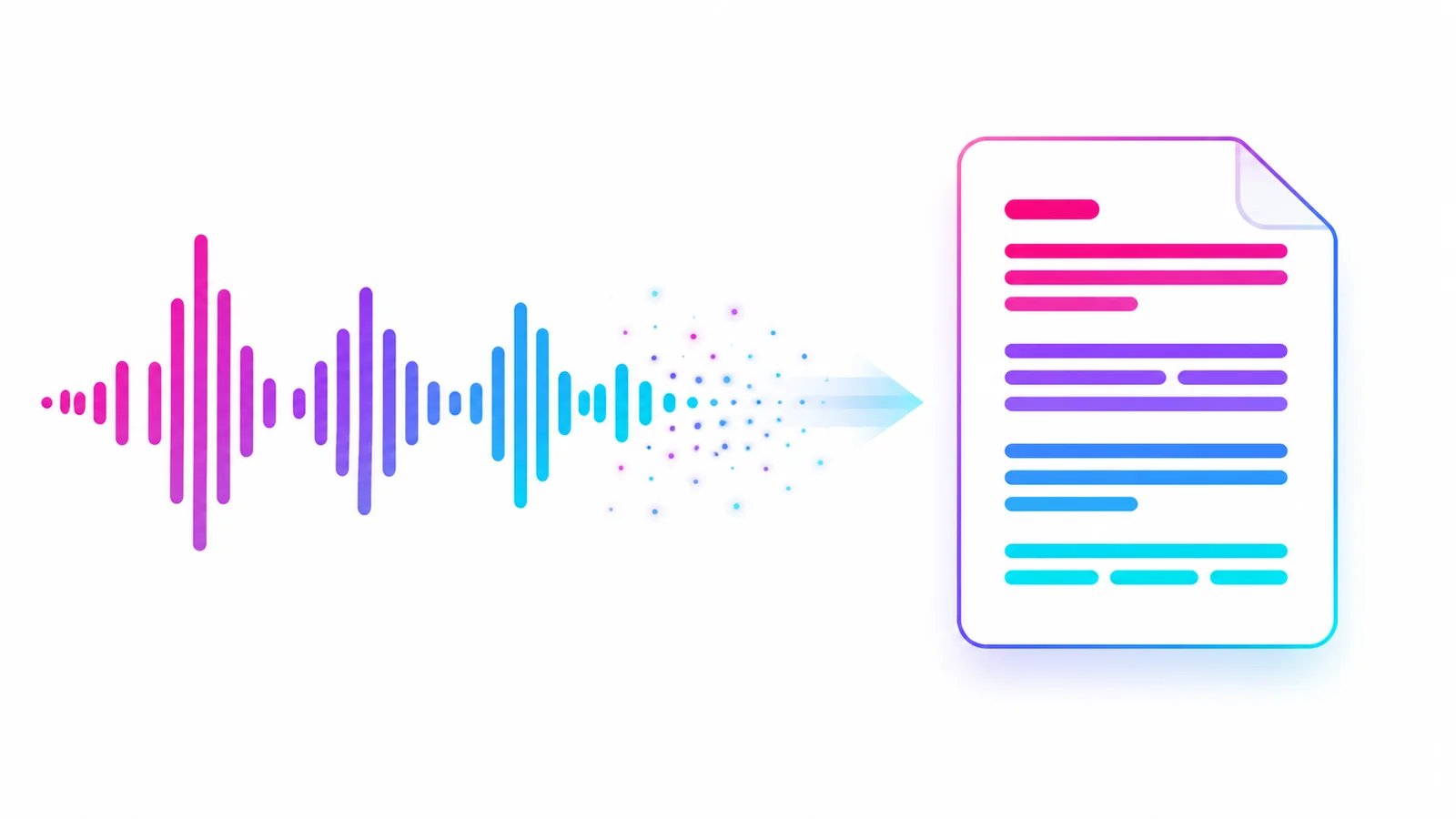
A transcript is a sentence-by-sentence written record of what was said in a recording or video. The least time-consuming way to produce one is usually not to type it yourself but to let an AI transcription tool draft it first and then proofread the names and terminology. With AIMochi, you send the audio to a LINE official account: the language is detected automatically, speakers are labelled, and the transcript comes back to your chat. Transcription costs 10 points per minute, and the 3,000 free points you get every month cover roughly 300 minutes.
Transcript, minutes, summary — three different documents
Transcript: keeps every sentence, filler words and repetitions included. Used whenever the exact wording has to be traceable — interviews, research, legal records, podcast subtitles.
Minutes: a structured, formal document covering the meeting details, the topics discussed, decisions, motions and who owns each action item.
Summary: a few paragraphs condensing the whole thing for a quick review.
In practice the order is transcript → minutes → summary: the last two are only as reliable as the transcript underneath them. The full workflow is covered in how to produce meeting transcripts. AIMochi has Anthropic's Claude model built in, so once the transcript exists you can generate summaries, minutes, press releases and more than ten other formats without switching tools.
Three ways to produce a transcript, and what each costs
1. Typing it by hand. Quality is the most controllable, but it takes real time: manual transcription usually takes several times the length of the audio, with published estimates ranging from 2–4 hours for experienced transcriptionists up to 4–6 hours. Poor audio, accents, several speakers or heavy jargon stretch that further. Outsourced quotes are normally based on recording length and vary with language, audio quality, number of speakers, terminology and turnaround, so ask the vendor directly.
2. Built-in transcription on a recorder or phone. Convenient and immediate, fine for short memos. What it can do varies by brand, model, region and language — some devices already handle multiple languages or label speakers, others only support specific ones. For long files and multi-speaker conversations, test with your own recordings before relying on it for anything official.
3. An AI transcription tool. The model does the recognition, far faster than a person typing, priced by the minute. The catch is that names, brands and specialist terms still need a human pass — so the right pattern is "AI drafts, human checks the key words". Chinese-language performance varies a lot between tools; see our comparison of Chinese voice-to-text tools.
If you handle more than one meeting or interview a week, the third option is usually the one worth evaluating — what it saves is not typing time but the time spent rewinding to find what someone said.
Making a transcript with AIMochi: three steps
Step 1 — add the LINE official account. Search for @aimochi or add it here. You receive 3,000 free points every month from the moment you do.
Step 2 — send the audio. Record with LINE, forward an existing voice message, or upload a file. On LINE for desktop, type /upload; you can also upload through app.aimochi.ai. MP3, WAV, M4A and AAC are supported.
Step 3 — collect the transcript. Processing takes roughly one sixth of the audio length, so an hour-long recording is back in about 10 minutes. More than 99 languages are supported and up to 10 speakers are labelled A, B, C. Export as one sentence per line, merged paragraphs or a subtitle file — subtitle files work for video captions, though encodings and formats differ between editing and publishing platforms, so check before uploading. To find something later, type "查詢筆記" in LINE. See the tutorial for the full walkthrough.
What it costs in points
The rules are simple: 1 point each time something is recorded (audio, image, link, text, file) and 10 points per minute of transcription. A 60-minute meeting therefore costs about 601 points.
The free plan gives 3,000 points a month, about 300 minutes. Basic is NT$299 a month for 18,000 points (including the 3,000 free ones) — roughly 1,800 minutes, or 30 hours. Team is NT$899 a month with 5 seats and 60,000 points, roughly 6,000 minutes or 100 hours, about NT$180 per seat. Regular points reset at the start of the next billing cycle, counted from your activation date rather than the calendar month, and do not roll over; referring a friend who enters your code adds 200 long-term points, which the monthly reset does not touch. Details are in the points guide.
Four things that make transcripts more accurate
Put the phone or microphone close to whoever is speaking — distance, background noise and echo all affect the result.
Try not to talk over each other; overlapping speech is a common difficulty for speech recognition and speaker separation.
Say the proper nouns once at the start, such as product code names or a client's full name, so they are easier to fix in one pass.
Produce the transcript before the summary — skipping it means errors get amplified by the summary with no way to check them.
FAQ
Does a transcript have to capture every word?
It depends on the purpose. Interviews, research and legal records usually need the original wording. For ordinary meetings, keeping the full meaning is enough, and filler words and repetitions can be removed — that version is generally called a cleaned-up transcript.
Does an AI transcript still need proofreading?
Yes. Names, company names, specialist terms and numbers should be the priority; the rest can be spot-checked according to how the transcript will be used.
Can it handle multiple languages in one recording?
AIMochi supports more than 99 languages and detects the language automatically, and you can translate or summarise the transcript afterwards. For recordings that mix languages within one conversation, test with your own material first.
Conclusion
The value of a transcript is that it is traceable, and producing one has gone from hours of typing to about ten minutes of processing plus a focused proofread. If your work regularly depends on what was actually said, switching to "record → AI transcript → check the proper nouns → generate minutes" saves the most time. Add the AIMochi official account and use your 3,000 free points on one meeting; if you want to turn those records into a searchable knowledge base, read what AI notes are.